


Energy Dome targets Australia’s first commercial CO2 battery

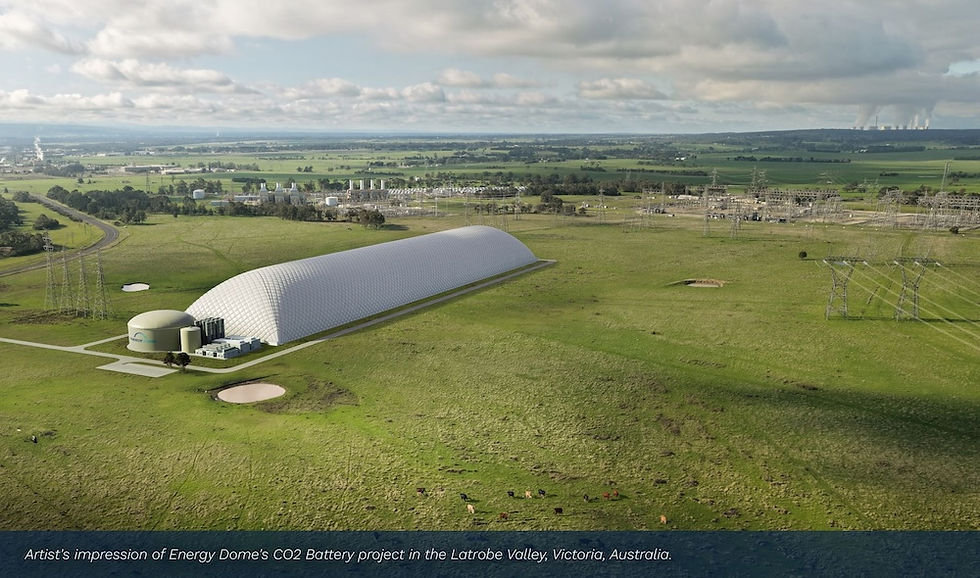
Energy Dome and a state-owned utility plan to install Australia’s first commercial compressed carbon dioxide (CO2) battery at a former coal-fired power station.
Victoria’s State Electricity Commission (SEC) will partner with Milan-based battery developer Energy Dome to deploy a 10-hour duration compressed CO2 battery energy storage system near Morwell, Australia.
The project, to be built as part of a new 143-hectare energy innovation precinct to be established adjacent to the decommissioned coal-fired Hazelwood power station, will feature a 20 MW/200 MWh compressed CO2 battery capable of running continuously for 10 hours.
Once built, the system will be Victoria’s first long-duration energy storage (LDES) facility – with more than double the duration of any battery operating in the state today – and Australia’s first commercial compressed CO2 battery.
The SEC said while Australia has seen a proliferation of battery energy storage in recent years, much of this has focused on shorter-duration technologies, providing two to four hours of energy storage to support the grid during peak demand periods.
SEC Chief Executive Officer Chris Miller said what makes the Hazelwood project particularly meaningful is that it reflects a growing recognition that long-duration energy storage is not just desirable, it is essential as power systems evolve.
“Long-duration energy storage will play a foundational, system-level role in Victoria’s future energy system, firming variable renewable generation from wind and solar to deliver the around-the-clock reliability of supply that’s needed to power our homes, businesses and communities,” he said. “As an integrated generator and retailer of 100% renewable electricity to commercial and industrial customers, we envisage long-duration energy storage will play a critical role in balancing our portfolio, enabling SEC to provide additional support to the system during multi-hour or multi-day wind or solar droughts.”
Energy Dome’s technology works by using grid power to compress CO2 gas into a highly dense liquid in a closed-loop thermo-mechanical system. When required, the liquid CO2 is expanded back into a gas through a turbine, generating electricity that is sent back to the grid. Crucially, the technology doesn’t rely on lithium or other rare earths so avoids critical-mineral supply-chain exposure.
The Italian company claims the system has a lifespan exceeding 30 years with no performance degradation, round-trip efficiency above 75%, and capital expenditure that is 1.7 times cheaper than lithium-ion batteries at comparable durations.
Energy Dome said the technology is already proven with a global pipeline of more than 30 GWh and projects underway in countries including the United States, Italy, Ireland and India.
Claudio Spadacini, founder and CEO of Energy Dome, said the Hazelwood project will provide Victoria with the long-duration storage and grid support needed to enable a more reliable, renewable-powered energy system.
“Victoria is retiring coal and gas while chasing its 2030 clean energy targets, and that transition calls for firm capacity measured in hours rather than short peaks,” he said. “The CO2 battery answers that need, and it brings the physical inertia and grid services that hold a system steady as older generators come offline.”
While no timeline has been provided for the Hazlewood project, the SEC said planning and design has begun, with early stakeholder and community consultation now underway.
The battery is to be the first of a number of projects slated for the new SEC Energy Works energy innovation precinct planned for the Latrobe Valley.
Miller said the 143-hectare precinct, located in Hazelwood North, will provide a space for SEC to partner with industry to develop a range of new energy infrastructure and storage technologies that the tstate’s future energy system will require.
“SEC is excited to support future energy innovation at the precinct, providing early investment and allowing industry to build confidence to take new energy technologies to the next stage of commercialization, while supporting more renewable projects to connect to the grid,” he said.
Miller said projects developed at SEC Energy Works will add to the government-owned renewable energy company’s growing portfolio of assets, with 1,024 MW of committed projects to date. This includes the Melbourne Renewable Energy Hub, and the solar-BESS hybrid SEC Renewable Energy Park.





Comments