


Southeast Asia’s Solar-Storage Revolution Faces Investment Barriers

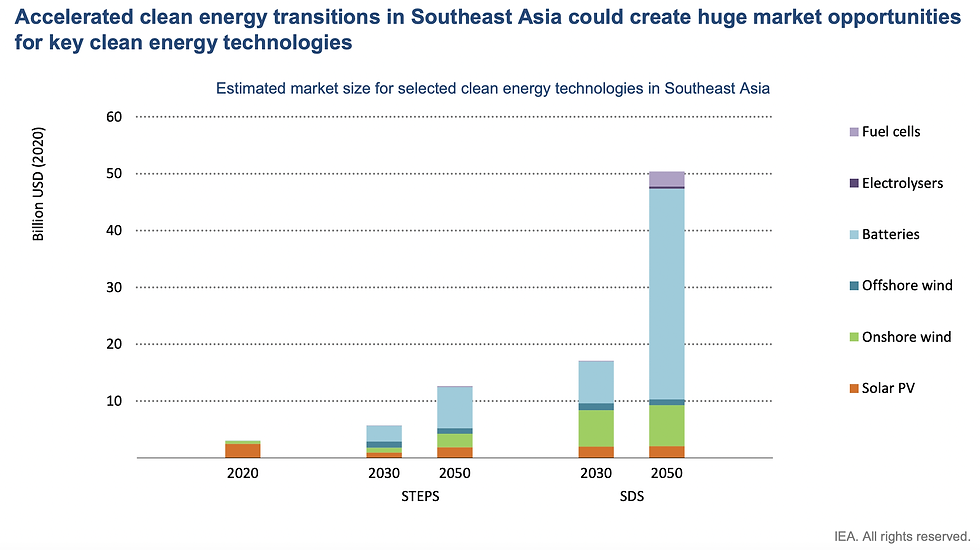
Southeast Asia is entering a major energy transition, with solar power and energy storage expected to become the dominant sources of renewable electricity by 2050. However, insufficient policy frameworks and a lack of investment transparency could limit the region’s ability to attract the capital needed to support the transition.
Southeast Asia is set to undergo a major transformation of its power sector over the next three decades, with energy storage expected to play an increasingly important role in supporting the region’s shift away from fossil fuels.
According to DNV, fossil fuels accounted for around 90% of Southeast Asia’s electricity generation in 2020. By 2050, however, their share is expected to fall to just 10% as renewable energy expands across the region. Solar photovoltaic generation, together with solar projects integrated with energy storage, is expected to provide 74% of the region’s electricity by the middle of the century.
The transition is being driven in part by growing concerns over energy security. Southeast Asian economies remain heavily dependent on fossil fuels, including imported energy resources, leaving them increasingly exposed to fluctuations in global energy prices and supply disruptions.
The International Energy Agency has therefore urged countries across the region to improve energy efficiency and accelerate renewable power deployment. Expanding domestic renewable generation could help Southeast Asian economies reduce their reliance on imported fossil fuels while meeting rapidly growing electricity demand.
Investment Needs to Rise Sharply
The transition, however, will require a substantial increase in investment.
The 10 ASEAN economies — the Philippines, Indonesia, Singapore, Thailand, Vietnam, Cambodia, Laos, Malaysia, Myanmar and Brunei Darussalam — are among the fastest-growing economies in the world. Their expanding populations, industrial activity and electricity demand will require significant investment in power generation, transmission networks, energy storage and other supporting infrastructure.
The IEA estimates that Southeast Asia needs around US$190 billion in annual energy investment by 2030 to meet its climate and energy transition objectives. This compares with approximately US$70 billion per year between 2016 and 2020.
A significant proportion of this investment is expected to flow into solar generation and energy storage, which are likely to form the foundation of the region’s future clean power system.
International investment will be particularly important. However, the IEA has warned that ASEAN countries need to demonstrate a clearer commitment to low-carbon energy deployment while strengthening their regulatory and financing frameworks if they want to reduce financing costs and attract more private capital.
Energy Storage Becomes Critical to Grid Stability
The rapid expansion of solar and other variable renewable energy sources will also create new challenges for Southeast Asia’s electricity grids.
As the share of solar and wind power increases, grid operators will need greater flexibility to balance fluctuations in renewable generation and electricity demand. Black & Veatch has warned that excessive penetration of variable renewable energy could create challenges for reliable grid operations across Asian electricity markets.
One potential solution is to integrate battery storage with existing gas-fired power plants.
Much of Southeast Asia’s gas-fired generation fleet is relatively young, with a significant proportion of the infrastructure having been built within the past decade. Rather than immediately retiring these assets, operators could potentially extend their economic lifetimes by integrating them with battery storage systems.
Battery systems with one to four hours of duration could help reduce the need to operate gas turbines during short periods of peak demand or renewable generation fluctuations. At the same time, combining storage with existing gas infrastructure could improve the flexibility of power plants and reduce their overall emissions.
Singapore Leads Regional Storage Deployment
Several Southeast Asian markets are already making progress in deploying large-scale energy storage.
In Singapore, the Sembcorp Energy Storage System, one of Southeast Asia’s largest battery storage projects, began operations on Jurong Island. The system has a capacity of 285MWh and was deployed in approximately six months.
Singapore has also emerged as a hub for energy storage technology development. Local battery company VFlowTech raised US$10 million in Series A funding, with the capital earmarked for establishing manufacturing capacity and scaling production of its vanadium flow battery systems.
The developments reflect Singapore’s broader strategy of strengthening energy resilience despite its limited land resources and heavy reliance on imported energy.
Thailand Builds Storage and Renewable Capacity
Thailand is also positioning energy storage as an important component of its renewable energy strategy.
Energy storage company Fluence and the Electricity Generating Authority of Thailand signed an agreement to explore the development of the country’s battery energy storage market.
Thailand has increased its target for non-hydro renewable energy from 20% to 30% by 2036, reflecting expectations of continued growth in solar and other renewable generation.
As renewable penetration increases, energy storage is expected to help stabilise the electricity grid and manage fluctuations in renewable output.
The country is also attracting investment in battery manufacturing. Gotion High-Tech’s local subsidiary has announced plans to develop battery pack and module manufacturing capacity in Thailand targeting both electric vehicles and stationary energy storage.
Meanwhile, Sungrow has partnered with Thailand’s Provincial Electricity Authority to explore opportunities in energy storage and green hydrogen. The company has already deployed more than 1GW of PV inverter capacity and more than 140MWh of energy storage in the country.
Vietnam Sees Growing Demand for Battery Storage
Vietnam is another key market for the region’s emerging energy storage sector.
AMI AC Renewables, a joint venture between Philippines-based AC Energy and Vietnam’s AMI Renewables, has partnered with Honeywell to develop a 15MW/7.5MWh battery energy storage system at a solar PV project in Khanh Hoa province.
The project is designed to demonstrate how battery storage can be integrated with solar generation and help address the challenges created by rapidly increasing renewable capacity.
Vietnam’s solar market has expanded rapidly in recent years. Solar generation grew from virtually zero in 2018 to more than 5GW, creating increasing pressure on the electricity system to manage renewable output.
Industry experts have argued that battery storage could help reduce renewable energy curtailment while improving the efficiency of existing solar assets and providing additional services to the grid.
Philippines Accelerates Solar-Plus-Storage Development
The Philippines is also placing greater emphasis on energy storage as part of its energy transition strategy.
President Ferdinand Marcos Jr. has highlighted the importance of incorporating energy storage into the country’s broader energy infrastructure, while the government has proposed regulatory changes designed to facilitate the integration of storage into electricity markets.
The Philippines has already commissioned several major solar-plus-storage projects.
A 40MW battery storage system combined with a 120MW solar PV plant in Alaminos, Laguna, became the country's first solar-plus-storage hybrid project. The country also hosts a large-scale battery storage facility in Bataan operated by San Miguel Corporation's Global Power Holdings.
Meanwhile, Terra Solar Philippines, a subsidiary of Prime Infrastructure Holdings, has announced plans for a massive solar-plus-storage project with 2,500–3,500MW of solar capacity and 4,000–4,500MWh of battery storage.
If developed as planned, the project would significantly increase the Philippines' solar and energy storage capacity and demonstrate the potential scale of renewable energy projects in the market.
Malaysia and Indonesia Also Attract Storage Investment
Malaysia and Indonesia are emerging as additional markets for long-duration energy storage.
Malaysia-based Reservoir Link has partnered with a US-based long-duration energy storage provider to explore the deployment of 200MW of energy storage solutions across Malaysia, Indonesia and Singapore between 2023 and 2027.
The partnership highlights growing interest in technologies beyond conventional lithium-ion batteries, particularly as Southeast Asian markets look for cost-effective solutions capable of providing longer-duration grid flexibility.
Policy and Investment Barriers Remain
Despite growing momentum across the region, Southeast Asia still faces significant barriers to fully realising the potential of renewable energy and storage.
Research from Imperial College London has highlighted inadequate policy and investment frameworks as a major reason why renewable energy development in the region continues to lag behind some other global markets.
Access to low-cost financing remains another major challenge. Investors often face uncertainty around project revenues, regulatory changes, currency risks and the long-term remuneration of renewable energy assets.
To address these issues, experts have called for greater transparency around project-level financial performance, stronger regulatory frameworks for renewable energy remuneration and more developed financial markets for clean energy and transition investments.
Development finance institutions and blended-finance mechanisms could also play a greater role in reducing investment risks. Greater access to hedging instruments could further help international investors manage currency and credit risks.
Regional grid connectivity will be another critical factor. As renewable generation becomes increasingly interconnected across Southeast Asia, stronger transmission infrastructure and cross-border electricity trading could allow countries to share resources more efficiently and improve overall system flexibility.
Solar and Storage Set to Reshape Southeast Asia’s Power Market
Southeast Asia offers significant long-term potential for the solar and energy storage industries. The region's rapidly growing electricity demand, combined with efforts to strengthen energy security and reduce dependence on fossil fuel imports, is expected to drive substantial investment in renewable generation and storage over the coming decades.
Solar PV and battery storage are likely to become increasingly interconnected, with storage helping utilities manage intermittency, reduce curtailment and provide additional flexibility to increasingly renewable-heavy power systems.
However, the scale of investment required means that governments will need to create more predictable policy and financing environments. Improving regulatory transparency, reducing investment risks and strengthening grid infrastructure will be essential if Southeast Asia is to attract the international capital needed for its clean energy transition.
With the region targeting a dramatic shift from fossil-fuel generation toward solar, storage and other renewable technologies, the coming decades could see Southeast Asia emerge as one of the world's most important growth markets for the solar-storage industry.





Comments